I just received a very interesting email from ACR (maker of the MicroFix and other fine PLBs) informing me about their new notification service that appears to be designed to compete with SPOT. Best I can tell, using a standard ACR PLB, when you activate a self test, a new server-side system will send an email or text message to up to five people. There is a subscription fee involved. The site is http://406link.com .
This seems like a really great idea and my hat is off to the people at ACR for forward thinking and staying up with the market.
However, I seem to recall reading in my Microfix and AquaFix manuals that the full system test (which is used to generate the Ok signal and notifications) should only be done once or twice during the five year life of the non-user replaceable litihium battery in the unit. Thus, it would seem that using the service on a regular basis by initiating the test sequence would be not be consistent with good battery life involving an emergency.
Doug, can you shed some light on this?
|
|
Being from the northern climes, I obsess about firemaking in the winter. I went out to my unheated shed recently to test a couple of cheap butane lighters that I had left out there for a few weeks. I thought that maybe a 6 inch pillar candle could provide fume free all-night heat in a car stuck on a rural road in a snowbank, a situation I have had the pleasure of being in. It was about 5 degrees below zero, and as expected the lighters did not light. I slid them into my gloves for 5 minutes while I puttered around in the shed, and they worked just fine. I lit the frozen pillar candle and within 10 minutes, the top half cracked into pieces, split right through. Back to the drawing board there. Anyway, here are my questions:
1. Looking at the SHOT show gadgets, I see that Zippo makes a fire starting kit in a metal Zippo-sized case...Why not just carry a Zippo?
2. If a $1 butane lighter works well wet or dry in any weather (as my personal test seems to indicate) why wouldn't a person's backup be another $1 butane lighter?
3. Why (for the love of Pete) would anyone carry a fire piston???
|
|
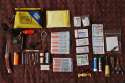
I'm planning a thru-hike of the Pacific Crest Trail(2,650 miles from the mexican border to the canadian border), and trying to lighten my pack weight. I have no intention of going 'ultralight', since being prepared and being ultralight are pretty much mutually exclusive, but there is certainly room for me to lighten my load while still being prepared. Right now I'm trying to lighten my first aid kit, which currently weighs 34oz, over 2 pounds! After my backpack, it's the single heaviest item on my gear list. I've already gone over everything in it and tried to remove the excessive items, but I would like some feedback from others. Just for comparison, the "first aid kit" that most thru-hikers bring consist of a tiny zip-lock with moleskin, a few band aids, and some Tylenol.
My goal is to be prepared for both major and minor medical situations, and have enough supplies so that I don't need to leave the trail or resupply early because I run out of materials to treat a non-severe injury. My kit is built from scratch using the container from AMK 'weekender' kit. The bag itself is fairly heavy, and I think the easiest way to cut a few ounces is to replace it with a lighter, perhaps sil-nylon bag. However I love the organization of this bag- the layout and the clear plastic pockets are perfect for me. I haven't yet found a lightweight case with similar organization, and I would appreciate any suggestions.
The first thing I would like to do is get a lighter case if I can find a suitable one, then work on trimming down the contents a bit. I'm also seriously considering skipping the First Aid book(5oz). It's a great book and in important item, but it's heavy and I'm pretty skilled in first aid(I've had EMT and recent WFR training).
edit: I've posted some pics, but I can't figure out how to attach the inventory file(pdf). I used the file manager, but its not showing up, can someone tell me how to post the file?
|
|
I have started posting reports on SHOT Show 2010. This year we are posting reports as they are produced to get them to you as quickly as possible, so check back often to read the latest reports.
(Having said that, I will be busy through the weekend in a Knife Rights Strategic Planning Meeting, so nothing new will be posted until Monday evening at the earliest, probably Tuesday.):
http://www.equipped.org/shot_show_2010.htm
|
|
OK, so I'm not usually one to worry about mega-disasters. Though I suppose a big hurricane hitting New York qualifies in some senses. However. . .
My brother just got back from a trip to Yellowstone. (Great trip - saw elk, bison, coyotes, wolves, and all sorts of cool geological features.) During the four days he was there, he reports that there were five hundred (500!!!) small earthquakes. Additionally, patterns in the geysers were changing - some becoming more frequent, some less, and some erupting in places where non had been previously.
I've always assumed that an eruption of the Yellowstone Caldera would qualify as a Very Bad Thing but never gave it too much thought.
So, for those who have done more research, is this something that I should be more concerned about? Is this change in seismic activity out of the ordinary? Any thought on what it means?
Jesselp, feeling a bit apocalyptic.
|
|
|
|
|
1
|
2
|
3
|
4
|
5
|
6
|
|
7
|
8
|
9
|
10
|
11
|
12
|
13
|
|
14
|
15
|
16
|
17
|
18
|
19
|
20
|
|
21
|
22
|
23
|
24
|
25
|
26
|
27
|
|
28
|
|
|
|
|
|
|
|
|